Digital Art in Barcelona: Where to See It in 2026
Digital art in Barcelona is spread across a surprising mix of places: a Gaudí house with an LED cube inside it, a contemporary art museum in the Born with mirrored infinity rooms, small Poblenou galleries, two November festivals and, from 17 October, a new immersive show in the Eixample built in a game engine. There is no single "digital art museum" that covers it all, so this guide maps where to see each kind of work, what it costs and what is actually open.
Every date and price below was checked on each venue's official website on 28 September 2026. SABDA, one of the venues on the list, is ours, and we flag it where it appears. Everything else is here because it is worth your time.
The short answer: where to see digital art in Barcelona now
- Casa Batlló for large-scale digital art inside a heritage building.
- Moco Museum for digital and immersive rooms next to Banksy and KAWS.
- SABDA for a 25 minute immersive show made in Unreal Engine, from 17 October.
- Codi Gaudí for mixed and virtual reality, until 8 January 2027.
- White Rabbit for rooms by Barcelona studios such as Onionlab and Playmodes.
- Load Gallery in Poblenou for free, gallery-scale digital work.
- MIRA (6 and 7 November) and LOOP (10 to 21 November) for festival programmes.
IDEAL, the city's best-known digital arts centre, has nothing announced after its Pompeii show closed on 21 September 2026. More on that below.
Real-time art vs a video on a loop: what is the difference?
Most immersive exhibitions you have seen are videos. An artist builds the images, the computer renders them once, frame by frame, and the result is saved as a file. In the room, that file is played back on projectors, usually on a loop. Every visitor sees exactly the same frames in the same order, because the images already exist before anyone walks in.
Real-time art works differently. It is made in a game engine, the same kind of software used to build video games. Unreal Engine, made by Epic Games, is the best known. Instead of storing finished frames, the engine stores a three-dimensional world: the landscape, the creatures, the light and the camera. It then calculates each frame live, many times per second, while you are watching.
Three things follow from that. First, the camera can travel through the world continuously, at any height and in any direction, because the world is actually there to move through. That is how a show can put you at an animal's eye level. Second, the image is generated for the exact shape of the room, so it can be built for four walls at once rather than stretched from a flat film. Third, a real-time work can change: the light can shift, the scene can evolve, and artists can adjust it between sessions without re-rendering hours of footage.
Real-time is not automatically better. It needs powerful computers, and a well-made video can look stunning. The difference is that a video shows you a film of a world, while a real-time work runs the world itself. SABDA's new immersive show is built in Unreal Engine. Headset VR, such as Codi Gaudí, is also rendered in real time, but inside a headset for one person rather than across a shared room.
Where to see digital art in Barcelona
Casa Batlló: the Gaudí Cube and façade mapping
Casa Batlló, on Passeig de Gràcia, is a Gaudí house that has become one of the city's main digital art venues. Every ticket includes the Gaudí Cube, a six-sided LED cube where Refik Anadol presents "Gaudí Dreams". The cube opened with Anadol's earlier piece "In the Mind of Gaudí". The studio United Visual Artists created "Beyond the Façade" and the "Hidden Order" façade mapping. Tickets start at €29, children up to 12 go free, and the house is open daily from 9:00 to 19:15. casabatllo.es
Allow: about 1 hour 15 minutes. Best for: digital art that responds to architecture.
Moco Museum: digital and immersive rooms in the Born
Moco Museum, in a palace on Carrer de Montcada, shows contemporary and street art alongside a dedicated "Digital & Immersive Art" collection. Current works include Studio Irma's "Diamond Matrix", a mirrored infinity room, Les Fantômes' "Infinite Parade" and pieces by the Barcelona studio Six N. Five. The museum also lists Krista Kim's "Heart Space" in its digital collection, though it notes that not every artwork is always on display. Tickets start at €14.95 online and children up to 6 go free. mocomuseum.com
Allow: about an hour. Best for: a first taste of digital art alongside big-name contemporary work.
SABDA's new immersive show (Eixample), from 17 October
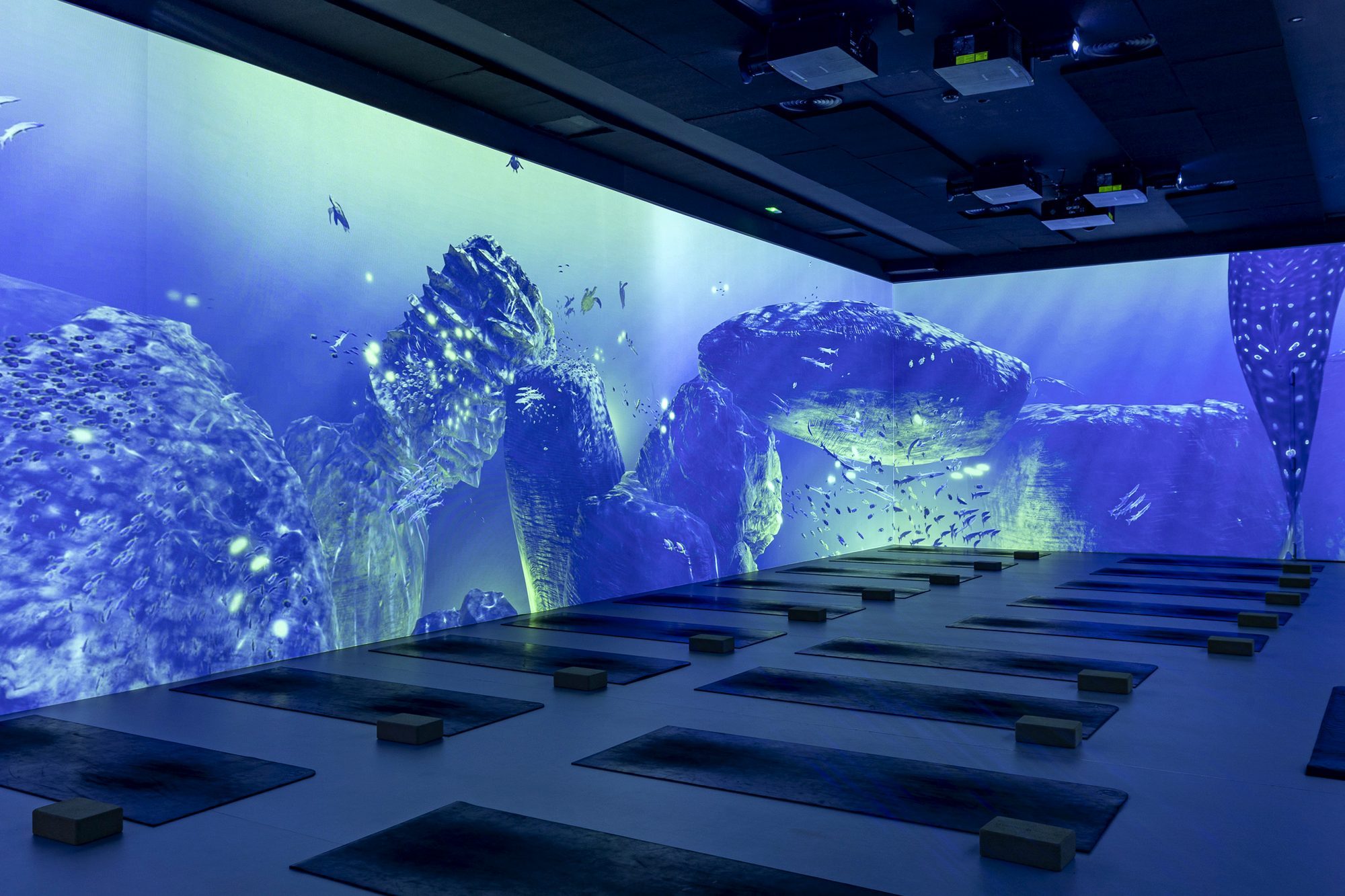
Full disclosure: SABDA is our venue. SABDA's new immersive show is a 25 minute journey through four worlds of life on Earth, made in Unreal Engine and projected across the four walls of a 360° room with Dolby Atmos sound, for 25 people per session at C/ Muntaner 83B in the Eixample.
The show opens on 17 October 2026 and runs on Fridays, Saturdays and Sundays. Tickets cost €20 for adults and €12 for children, and include a welcome glass of cava or juice in SABDA Café. You travel at animal eye level and, for 25 minutes, become one of them. There is no headset. The nearest metro is Universitat. Details are on SABDA's exhibitions page.
Allow: 25 minutes, plus the welcome drink. Best for: seeing what art made in a game engine feels like at room scale.
Codi Gaudí at Espai Imagina
Codi Gaudí is an extended reality exhibition about the buildings Gaudí designed but never built, at Espai Imagina (Av. Diagonal 177, in the Mediapro building near Glòries). It combines mixed reality, virtual reality headsets, augmented reality and large-scale projection, and runs from 22 September 2026 to 8 January 2027. Adult tickets cost €12.50 on Mondays, €17.50 from Wednesday to Friday and €23 at weekends; it is closed on Tuesdays. VR is recommended from age 6. espai-imagina.com
Allow: about 70 minutes. Best for: headset-based VR.
White Rabbit: Barcelona studios on Passeig de Gràcia
White Rabbit, "The Off-Museum" at Passeig de Gràcia 55, is an immersive experience about Catalan traditions spread over ten rooms by local artists. They include a 360° AI cube by Onionlab and rooms by Playmodes and La Fura dels Baus. General tickets start at €16, and it is open daily from 10:00 to 20:00. The visit takes 60 to 90 minutes.
Best for: seeing the work of Barcelona's own digital studios in one place.
IKONO and Dalí Boulevard Cibernètic
IKONO, on the third floor of the Arenas shopping centre, is a playful immersive museum of more than ten photo-friendly rooms, open from 12:00 to 19:00. It is closer to an interactive playground than to digital art. Dalí Boulevard Cibernètic, in Casa Amatller at Passeig de Gràcia 41, is an immersive take on Dalí's work from €15 on weekdays and €18 at weekends, with a visit of about 75 minutes.
IDEAL Centre d'Arts Digitals: check before you go
IDEAL has been the city's reference for large projection shows. Its latest, "The Last Days of Pompeii" at IDEAL Montjuïc, closed on 21 September 2026, and nothing new is announced for October or November. IDEAL's website currently lists only its Montjuïc venue (Plaça de Carles Buïgas 7), with no programme for the original Poblenou space. If you are planning around IDEAL, check idealbarcelona.com before you go.
Digital art galleries and centres in Barcelona
Load Gallery, Poblenou. A gallery dedicated to digital art at Carrer de Llull 134, open Thursday to Saturday, with free admission. Its current group show, "Rituals of Time", runs until 16 January 2027. Past shows include Desilence, niceaunties and Six N. Five. load-gallery.com
Arts Santa Mònica, La Rambla. A free public arts centre run by the Catalan government. Its main summer exhibition closed on 27 September; its 2026 programme announces "Boom Crash Candy Crush", curated by Joana Moll with Hito Steyerl, Aram Bartholl and Mediengruppe Bitnik, from 29 October 2026 to 31 January 2027. Weekly video, sound and performance sessions continue in between.
Espronceda, Sant Martí. An art centre at C/ Espronceda 326 that shows new media work, including VR and spatial audio projects. Outside its opening events, visits are by appointment.
Hangar and Canòdrom. Hangar in Poblenou is a production centre for artists rather than a gallery, but it holds public talks, such as a book presentation on 19 October. Canòdrom, the city's Ateneu for digital and democratic innovation, hosts a workshop on creative uses of AI on 17 October.
Digital art festivals in Barcelona
MIRA Digital Arts Festival: 6 and 7 November 2026. MIRA takes over Fira Montjuïc with audiovisual shows, installations and 360° fulldome pieces. The 2026 line-up includes Max Cooper, Arca, Helena Hauff, Nicola Cruz and Tortoise. A full pass costs €110 and a day pass €60, plus fees. mirafestival.com
LOOP Barcelona: 10 to 21 November 2026. LOOP is a video art festival spread across museums, galleries and cinemas, curated this year by Filipa Ramos. The LOOP Fair, where each project is shown in a hotel room, runs from 17 to 19 November. loop-barcelona.com
Llum BCN: 5 to 7 February 2027. The city's free festival of light art returns for its 16th edition around Poblenou.
Sónar: 17 to 19 June 2027. Sónar has confirmed its 2027 dates. Separate dates for Sónar+D, its technology and creativity congress, are not yet published.
Not in Barcelona this season: LEV Festival held its 2026 editions in Gijón and Madrid, not Barcelona. MUTEK Barcelona has moved to a two-year cycle and has not published its next dates.
How to plan a digital art day in Barcelona
Eixample in one afternoon. Casa Batlló, Dalí Boulevard Cibernètic and White Rabbit are all on Passeig de Gràcia, within a few minutes' walk of each other. SABDA is a short walk away on Muntaner, and its 25 minute show fits at the end of the day on a Friday, Saturday or Sunday.
Poblenou for the galleries. Load Gallery (Thursday to Saturday) and Hangar are both in Poblenou, which is also where Llum BCN happens in February.
Born for a mix. Moco Museum sits on the same street as the Museu Picasso, which is useful if you are travelling with someone who prefers painting.
Prices at a glance
| Venue | What it is | Adult from | Allow |
|---|---|---|---|
| Casa Batlló | Gaudí Cube, façade mapping | €29 | 1 h 15 min |
| Moco Museum | Digital and immersive rooms | €14.95 | 1 hour |
| SABDA | 25 minute immersive show, Unreal Engine | €20 | 25 min |
| Codi Gaudí | Mixed and virtual reality | €12.50 (Mondays) | 70 min |
| White Rabbit | Ten immersive rooms | €16 | 60 to 90 min |
| Dalí Boulevard Cibernètic | Immersive Dalí | €15 | 75 min |
| Load Gallery | Digital art gallery | Free | 30 min |
| MIRA | Festival, 6 and 7 November | €60 day pass | Full day |
For more immersive options, see our guide to the best immersive experiences in Barcelona and the full list of Barcelona exhibitions in October.
FAQ
Is there a digital art museum in Barcelona? Not in the sense of one permanent museum. IDEAL Centre d'Arts Digitals is the city's dedicated digital arts centre, but nothing is announced after its Pompeii show closed on 21 September 2026. Moco Museum has a permanent digital and immersive collection, and Casa Batlló includes the Gaudí Cube with every ticket.
What is the best digital art exhibition in Barcelona right now? For large-scale digital art, the Gaudí Cube at Casa Batlló. For a mix of digital rooms and contemporary art, Moco Museum. For art made in a game engine at room scale, SABDA's new immersive show from 17 October. For free work, Load Gallery in Poblenou.
What is the difference between real-time art and an immersive video? An immersive video is rendered in advance and played back as a file, so every visitor sees the same frames. Real-time art is made in a game engine such as Unreal Engine, which calculates each frame live from a 3D world while you watch, so the camera can move freely and the scene can change.
Is teamLab in Barcelona? No. teamLab has no venue or exhibition in Barcelona or elsewhere in Spain at the moment. Our teamLab Barcelona guide covers the closest alternatives.
When is the MIRA festival 2026? MIRA Digital Arts Festival takes place on 6 and 7 November 2026 at Fira Montjuïc. A full pass costs €110 and a day pass €60, plus fees.
Where can I see digital art for free in Barcelona? Load Gallery in Poblenou is free, from Thursday to Saturday. Arts Santa Mònica on La Rambla is always free. Llum BCN, the light art festival, is free and returns from 5 to 7 February 2027.
How long is SABDA's new immersive show and how much does it cost? It lasts 25 minutes and costs €20 for adults and €12 for children, including a welcome glass of cava or juice in SABDA Café. It runs on Fridays, Saturdays and Sundays from 17 October 2026.