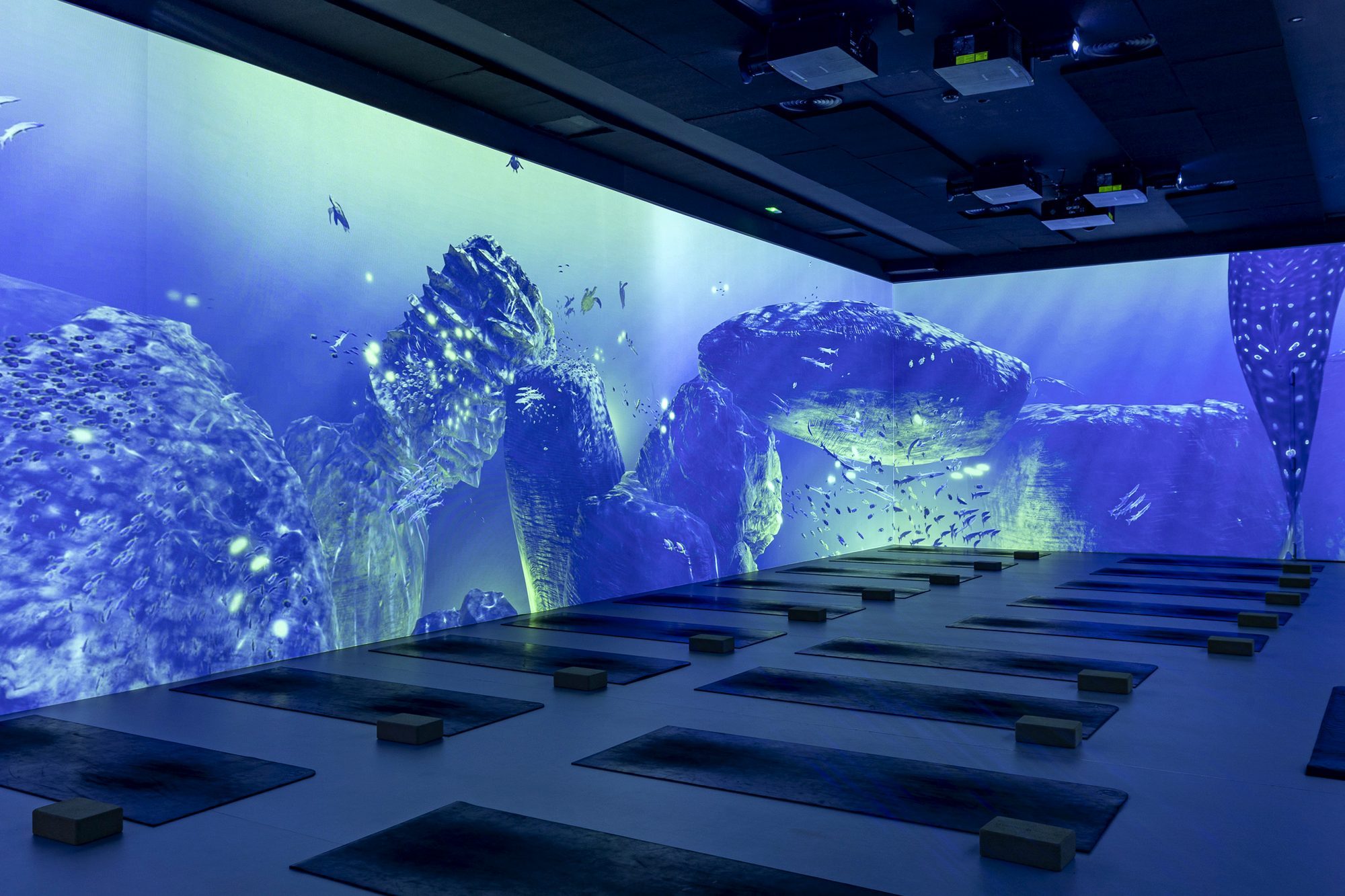
Here's a question nobody asks about wellness spaces: what speakers are they using? It seems like an odd detail. But if you've ever done a sound healing session in a normal room and then done one in a room with cinema-grade Dolby Atmos spatial audio, you'd understand why the room might matter more than the practitioner.
What Dolby Atmos is (quickly)
Traditional audio is channel-based: stereo (left and right) or surround (5.1, 7.1. Sounds come from fixed speaker positions). Dolby Atmos is object-based: sound is placed in 3D space. An audio object can be positioned anywhere. Above you, behind you, moving in a circle around you, rising from the floor.
In a cinema, this means a helicopter can fly over your head. In a wellness space, this means a Tibetan singing bowl tone can orbit your body.
What it means for sound healing
In a standard sound healing session, the practitioner sits at one end of the room. The sound radiates from their instruments, bounces off walls, and reaches you from roughly one direction. It's pleasant. It works.
In SABDA's Dolby Atmos room, the same instruments are captured and distributed through speakers in every wall, the ceiling, and subwoofers in the floor. The sound doesn't come from "over there". It comes from everywhere simultaneously. A bowl tone arrives from your left, moves above you, descends on your right. Bass frequencies vibrate through the floor into your spine.
The neurological difference: when sound arrives from a single direction, your brain localises it (it knows where the sound is, so it's partially in "alert" mode). When sound arrives from everywhere, your brain can't localise it, and it stops trying. That surrender of spatial processing is what produces the deeper relaxation states.
What it means for breathwork
In a breathwork session, the facilitator's cues are critical: "inhale.. hold.. exhale." In a stereo room, the voice comes from the front. You're receiving instructions from a person.
In Dolby Atmos, the voice arrives from all around you. It doesn't feel like someone talking to you. It feels like the instruction is inside your own head. The psychological effect: you follow more naturally, you go deeper faster, and the gap between "I'm doing an exercise" and "this is happening to me" shrinks.
The music in a breathwork session also benefits enormously. During the activating phase, the music builds from every direction, creating a physical sense of pressure and expansion. During the calming phase, it recedes into gentle, ambient wrapping. The transitions between phases feel organic rather than mechanical.
What it means for yoga and pilates
Less dramatic than sound healing, but still meaningful. The teacher's voice in spatial audio has more presence and clarity. You hear instructions without straining. The music doesn't compete with the voice; it occupies a different spatial position. And for classes like yin yoga, where you hold postures for 3-5 minutes in stillness, the ambient soundscapes create an envelope of attention that keeps your mind from wandering.
The setup at SABDA
SABDA uses invisible in-wall speakers and ceiling-mounted arrays, plus subwoofers embedded in the floor. Combined with 360° LCD laser projections on every surface, the room creates total sensory immersion: visual + auditory + tactile (bass frequencies you feel physically).
The system runs on cinema-grade hardware. The same technology used in Dolby Cinema theatres, adapted for a wellness space. To our knowledge, SABDA is the only wellness studio in Europe using Dolby Atmos spatial audio.
Why this matters
Most wellness spaces compete on teachers, class variety, and interior design. SABDA competes on physics. The room is the differentiator. A good teacher in a standard room produces a good session. The same teacher in a room where sound moves in 3D and visuals surround you produces something categorically different.
You don't need to understand the technology to experience the difference. You just need to lie down, close your eyes, and notice that the sound is everywhere. 3 classes for €50.
Related: What Is Sound Healing? | La ciencia del bienestar inmersivo (ES) | Classes at SABDA
---
Who else is doing this?
Globally, the intersection of audio technology and wellness is emerging. Some meditation apps use binaural beats (two slightly different frequencies in each ear to create a perceived third frequency). High-end spas in Tokyo and London are experimenting with multi-speaker sound environments. And a handful of yoga studios in LA and New York have installed surround sound systems.
But Dolby Atmos. Cinema-grade, object-based spatial audio with dozens of individually addressable speakers, in a wellness studio? That's a different category. SABDA is, to our knowledge, the first studio in Europe to use this level of audio technology for wellness classes. The system wasn't adapted from a cinema. It was designed specifically for the space, with speaker placement optimised for prone and supine positions (lying face-up and face-down, how most wellness activities are experienced, not sitting in a cinema seat facing forward).
The result is a level of audio immersion that earbuds, headphones, and standard studio speakers simply cannot replicate. Sound that moves around your body. Bass that vibrates through the floor into your spine. Tones that arrive from above and dissolve downward. It's the difference between listening to the ocean on Spotify and lying on the beach with waves breaking around you.
Try it
Words can't fully convey the difference spatial audio makes for wellness. It needs to be experienced. 3 classes at SABDA for €50. Sound healing is the best starting point to understand what the room can do.