Your First Class at SABDA: What to Expect, What to Bring, and What Actually Happens Inside the Room (2026)
You're about to go to SABDA studio Barcelona for the first time. You've seen the Instagram videos but you're not entirely sure what you're walking into. That's normal. The first time you enter the room is a moment most people remember. This guide covers the practical stuff so you can show up relaxed and focus on the experience.
Before you go
Book online. All classes are booked through Momence. Pick a class, select date and time, complete the booking. The 3-class pack for €50 (€18/class) is the best way to start. It lets you try different formats and find what resonates.
What to wear. Comfortable clothes you can move in. That's it. SABDA provides yoga mats, blankets, and everything else you need. For pilates, grip socks are recommended (you can buy them at reception if you don't have any). No special gear required.
When to arrive. 10 minutes before class. That gives you time to check in, put your things away, and settle into the space before it starts. The transition from street to room is part of the experience, so don't rush it.
Which class to pick first. If you want to relax (and you've never done anything like this): sound healing. You lie down and the sound does the work. If you want movement: vinyasa yoga. If you want something physical and structured: pilates. If you want something intense: breathwork. All classes are open to all levels.
When you arrive
Mica or the reception team will greet you. There's an area for bags and shoes (classes are barefoot or in socks). Changing rooms with showers are available if you're coming from work or heading somewhere after.
You'll be directed to the room. And when you walk in...
Inside the room
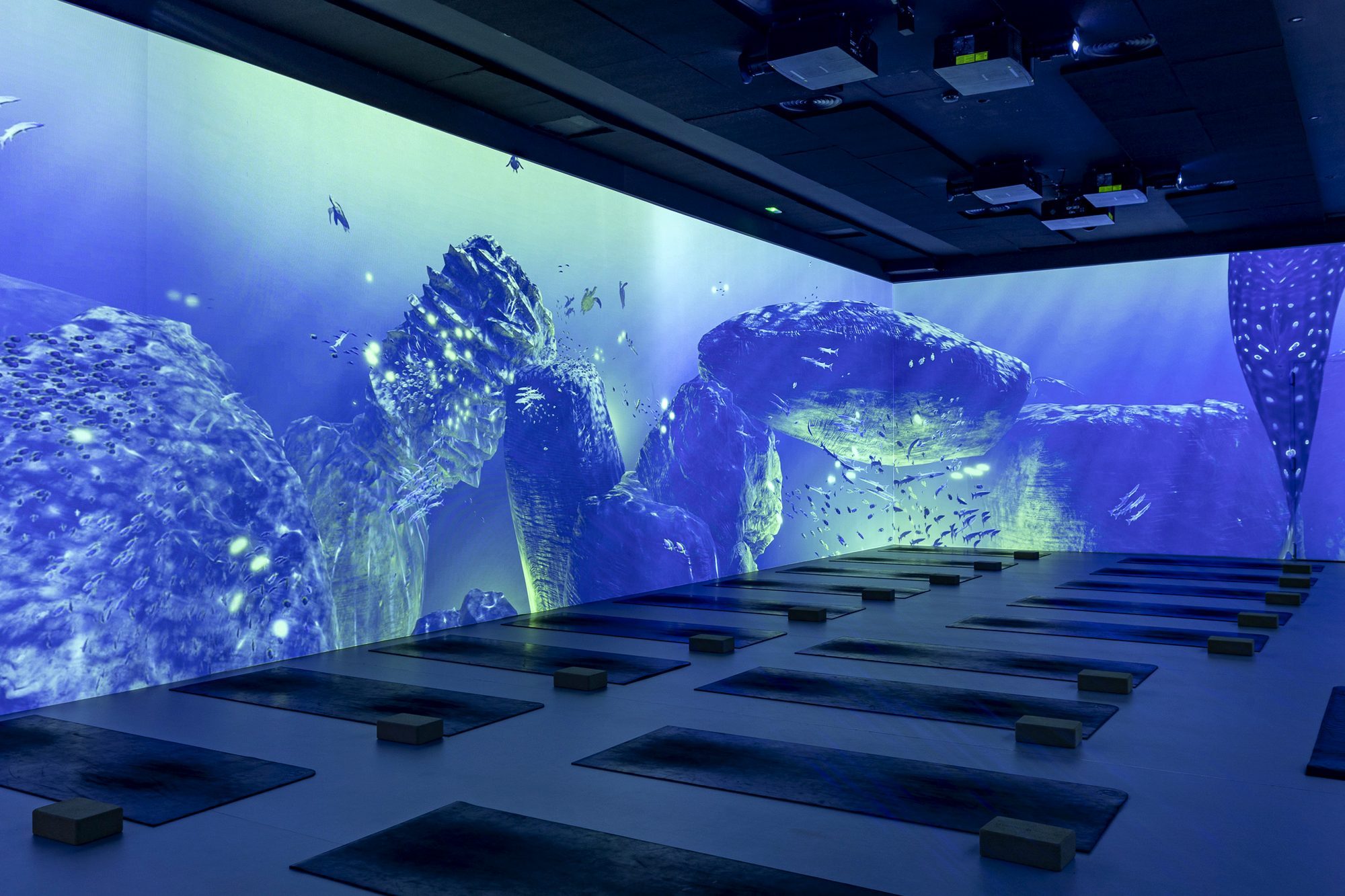
The first impression is what people talk about afterward. The room is dark. The projections are already active: slow-moving colours, organic geometries shifting across the walls and ceiling. The spatial audio fills the space with something that feels more like an environment than music. It's not loud. It's surrounding.
You pick up a mat, find your spot, and wait for class to start. There are no mirrors. No windows. The outside world disappears. That's intentional.
The room capacity is 80 seated. But classes typically have 15-25 people, so there's plenty of space. You won't be elbow to elbow with strangers.
During class
The teacher guides the session. The projections shift with the phases of the class: more dynamic during active portions, slower during relaxation. The spatial audio makes the teacher's voice and the music arrive from all directions.
If it's yoga or pilates: You follow the teacher's instructions. All levels welcome. If a pose doesn't work for you, rest. Nobody's watching (the room is dark). The teacher will offer modifications verbally. In vinyasa, expect to move through sun salutations, standing sequences, balance work, and a floor sequence before savasana. In pilates, expect structured core work, controlled movements, and precise alignment cues. Both formats run 60 minutes.
If it's sound healing: You lie down, close your eyes, and let the sound wash over you. You don't have to do anything. The Dolby Atmos system means the sound moves around you, above you, through the floor. Tibetan bowls, crystal bowls, gongs, and ambient frequencies layer together. It's a fundamentally different experience from sound healing with a single speaker. Sessions run 60 minutes. Some people fall asleep. That's fine.
If it's breathwork: You follow the breathing patterns the facilitator guides. It can be intense. Your hands might tingle. You might feel emotional. You might feel a rush of energy or a deep calm. All normal. The breathwork at SABDA follows structured patterns that alternate between activating phases (faster breathing, building energy) and integrating phases (slow breathing, releasing). If it's too much at any point, just return to normal breathing. Nobody will know or care.
If it's ecstatic dance: No choreography. No talking. No phones. You move however your body wants to move. The projections respond to the collective energy. The music follows an arc from slow ambient through to a high-energy peak and back down to stillness. It sounds strange until you try it. Then it makes sense. Sessions run 60-90 minutes.
Phone: Off or silent. No photos during class. The space is phone-free by design. This isn't a rule to be annoying. It's what makes the experience work. The moment someone checks their phone, the immersion breaks for everyone around them.
What each class format feels like (honest version)
Vinyasa yoga: Physical, flowing, sweaty. You'll feel like you exercised. The immersive visuals sync with the flow of the class, faster during sun salutations, slower during holds. By savasana, you've forgotten the projections are there. That's the point.
Sound healing: You do nothing and everything happens. The first 10 minutes you might think "is this it?" Around minute 15, something shifts. Your body gets heavy. Your mind gets quiet. By minute 30, most people are in a state somewhere between deep relaxation and sleep. You leave feeling like you slept for 8 hours.
Breathwork: The first 15 minutes feel manageable. The next 15 feel intense. The last 30 minutes, when the breathing pattern shifts from active to slow, feel like floating. It's the most physically demanding class that involves zero movement. You'll feel it in your diaphragm the next day.
Pilates: Structured, precise, deceptively hard. The immersive environment doesn't make pilates easier. It makes you more aware of your body during each exercise, which means you work harder because you notice when you're cheating. Core Pilates focuses on deep stabilisation. Power Pilates adds tempo and cardio elements. Both leave your abs burning.
Yin yoga: Slow. Very slow. You hold each posture for 3-5 minutes without moving. The challenge isn't physical. It's staying still when your brain wants to fidget. The immersive room helps enormously here because the projections give your visual mind something to settle on instead of the clock.
After class
Take your time. Don't jump up immediately, especially after sound healing or breathwork. Sit for a moment. Drink water (available in the space).
Showers are available. Reception can help you book your next class or figure out how to use the rest of your pack.
How to get there
Address: C/Muntaner 83B, Local 2, 08011 Barcelona. Metro: Universitat (L1, L2), 10-minute walk up Muntaner. Walking from Passeig de Gràcia: 12 minutes. Bicing: Station at Muntaner/Consell de Cent.
The entrance is at street level on Muntaner. Look for the SABDA sign. It's between Consell de Cent and Diputació.
First-timer questions
Do I need to be flexible or fit? No. Every class is for all levels. Teachers give modifications. Nobody judges you. The room is dark.
What if I can't keep up? Rest whenever you want. Child's pose in yoga. Lie down in breathwork. Stand still in ecstatic dance. Nobody notices.
Is it weird going alone? No. Most people come alone. These are individual experiences in a shared space. You don't need a partner or a friend.
Can I shower after? Yes. Changing rooms with showers are available.
Can I book a single class without the pack? Yes, drop-in is €18. But the 3-class pack for €50 (€18/class) is better value and lets you try different formats.
What's the best second class? If you did sound healing first, try vinyasa yoga or breathwork. If you did yoga, try sound healing or pilates. The immersive room changes every class format, so each experience is genuinely different.
After your first class
Most people leave their first class at SABDA slightly dazed, deeply relaxed, and wondering why they waited so long to try it. The second class is where you start to understand the difference the environment makes. You enter focus faster because you know what to expect. By the third, most people have found their favourite format and are considering a membership.
That's the design of the 3-class pack: try enough to find what works for you. Memberships start at €99/month (Flex, 4 classes) if you decide to stay. Most people know by the third class whether SABDA fits into their routine. And if it does, you'll wonder why every studio doesn't look like this.
Book your first class → | See the full schedule
Related: Classes at SABDA | Yoga in Barcelona | What Is Sound Healing